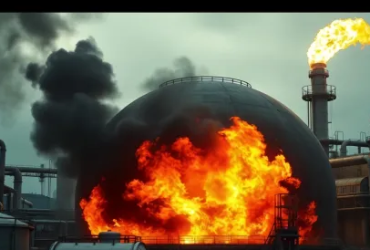
Safety refers to the condition of being protected from harm, danger, or risk. In the context of the workplace or daily life, safety involves taking steps to prevent accidents, injuries, and other negative outcomes by identifying hazards, minimizing risks, and ...
Operator Zone – Oil & Gas Interview Questions Latest Questions
Admin WebsiteBegginer
PSM stands for Process Safety Management. It is a regulatory framework and system designed to help companies prevent and manage the risks associated with the handling of hazardous chemicals and processes. The goal of PSM is to protect employees, the ...
Admin WebsiteBegginer
OSHA stands for the Occupational Safety and Health Administration, which is a division of the U.S. Department of Labor. OSHA was created by the Occupational Safety and Health Act of 1970 to ensure safe and healthy working conditions for employees ...
Admin WebsiteBegginer
API Gravity is a measure of how heavy or light a petroleum liquid is compared to water. It is a scale developed by the American Petroleum Institute (API) to quantify the density of crude oil and other liquids. API Gravity ...
Crude oil can be classified into several types based on its characteristics, such as density, sulfur content, and origin. These characteristics significantly influence how crude oil is refined and its final uses. Here are the main types of crude oil: 1. ...
Vaporization and evaporation are both processes by which a liquid changes into a gas, but they occur under different conditions and have distinct characteristics. Here’s a breakdown of the key differences between the two: Vaporization: Definition: Vaporization is the process by which ...
Vacuum Distillation is a special type of distillation process that is used to separate components of a mixture by lowering the pressure (creating a vacuum) in the distillation system. This process helps to reduce the boiling points of the components, ...