
Share & grow the world's knowledge!
We want to connect the people who have knowledge to the people who need it, to bring together people with different perspectives so they can understand each other better, and to empower everyone to share their knowledge.
Latest Technical Articles
Operator Zone – Technical knowledge hub Latest Articles

Urea Plant – Important Technical Terms
1. Ammonia (NH₃) Basic raw material for urea production. Produced from natural gas in the ammonia plant section. 2. Carbon Dioxide (CO₂) Second main feedstock. Comes as a by-product from ammonia production and reacts with ammonia to form urea. 3. ...

Urea Manufacturing Process – Complete Industrial Guide
1. Introduction Urea is one of the most widely used nitrogen fertilizers in the world. It contains about 46% nitrogen, making it the highest nitrogen-content solid fertilizer available commercially. Urea is essential for agricultural productivity and is used globally to ...

Offshore Operations and Processes in the Oil & Gas Industry
Offshore Operations and Processes in the Oil & Gas Industry The offshore oil and gas industry is one of the most advanced and technically demanding sectors in the global energy market. Offshore operations involve extracting crude oil and natural gas ...
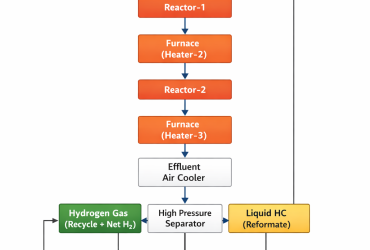
Catalytic Reformer Unit PFD | Process Flow Diagram of Reformer Unit Explained
A Refinery Reformer Unit (commonly called a Catalytic Reformer Unit) is one of the most important processing units in a petroleum refinery. It is mainly used to upgrade low-quality naphtha into high-octane gasoline components and to produce hydrogen gas, which ...

CRUDE DISTILLATION UNIT (CDU): A COMPREHENSIVE TECHNICAL GUIDE
# **CRUDE DISTILLATION UNIT (CDU): A COMPREHENSIVE TECHNICAL GUIDE** ## **1. INTRODUCTION AND OVERVIEW** The Crude Distillation Unit (CDU), also known as the Atmospheric Distillation Unit (ADU), represents the cornerstone of petroleum refining operations worldwide. As the primary separation process ...
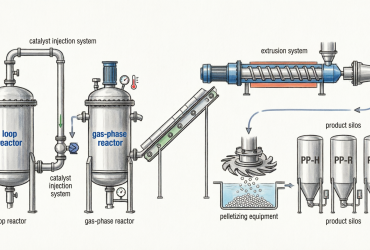
POLYPROPYLENE UNIT (PPU): A COMPREHENSIVE TECHNICAL GUIDE
# **POLYPROPYLENE UNIT (PPU): A COMPREHENSIVE TECHNICAL GUIDE** ## **1. INTRODUCTION AND OVERVIEW** The Polypropylene Unit (PPU) represents one of the most significant and versatile polymer production facilities in the petrochemical industry. Polypropylene (PP), with the chemical formula (C₃H₆)ₙ, is ...
What is a DCS (Distributed Control System) & How a DCS Works ?
A Distributed Control System (DCS) is an industrial control system used to monitor and control large and complex processes in industries such as oil & gas, power plants, chemical plants, and refineries. Instead of controlling everything from one central computer, a DCS spreads the control acrossRead more
A Distributed Control System (DCS) is an industrial control system used to monitor and control large and complex processes in industries such as oil & gas, power plants, chemical plants, and refineries.
Instead of controlling everything from one central computer, a DCS spreads the control across multiple controllers placed in different areas of the plant. These controllers work together and communicate with a central control room where operators can monitor and manage the entire process.
How a DCS Works
A DCS collects data from different field devices like sensors, flow meters, pressure transmitters, and temperature gauges. This data is sent to local controllers. Each controller manages its own section of the plant and makes quick decisions based on the incoming signals.
The information is then displayed in the control room on operator screens (HMI – Human Machine Interface), where engineers can supervise the whole process in real time.
If any abnormal condition occurs, the system can automatically take action, such as adjusting valves, stopping pumps, or triggering alarms.
Simple Example
Imagine an oil refinery:
Each section has its own controller, but all are connected to a central control room.
If the pressure in a storage tank becomes too high, the DCS immediately detects it and can automatically open a relief valve or reduce the inflow to prevent any accident. At the same time, an alarm appears on the operator’s screen.
Key Idea
A DCS is designed for continuous and large-scale industrial processes where safety, accuracy, and real-time control are very important.
It helps operators manage complex plants efficiently while reducing the risk of human error.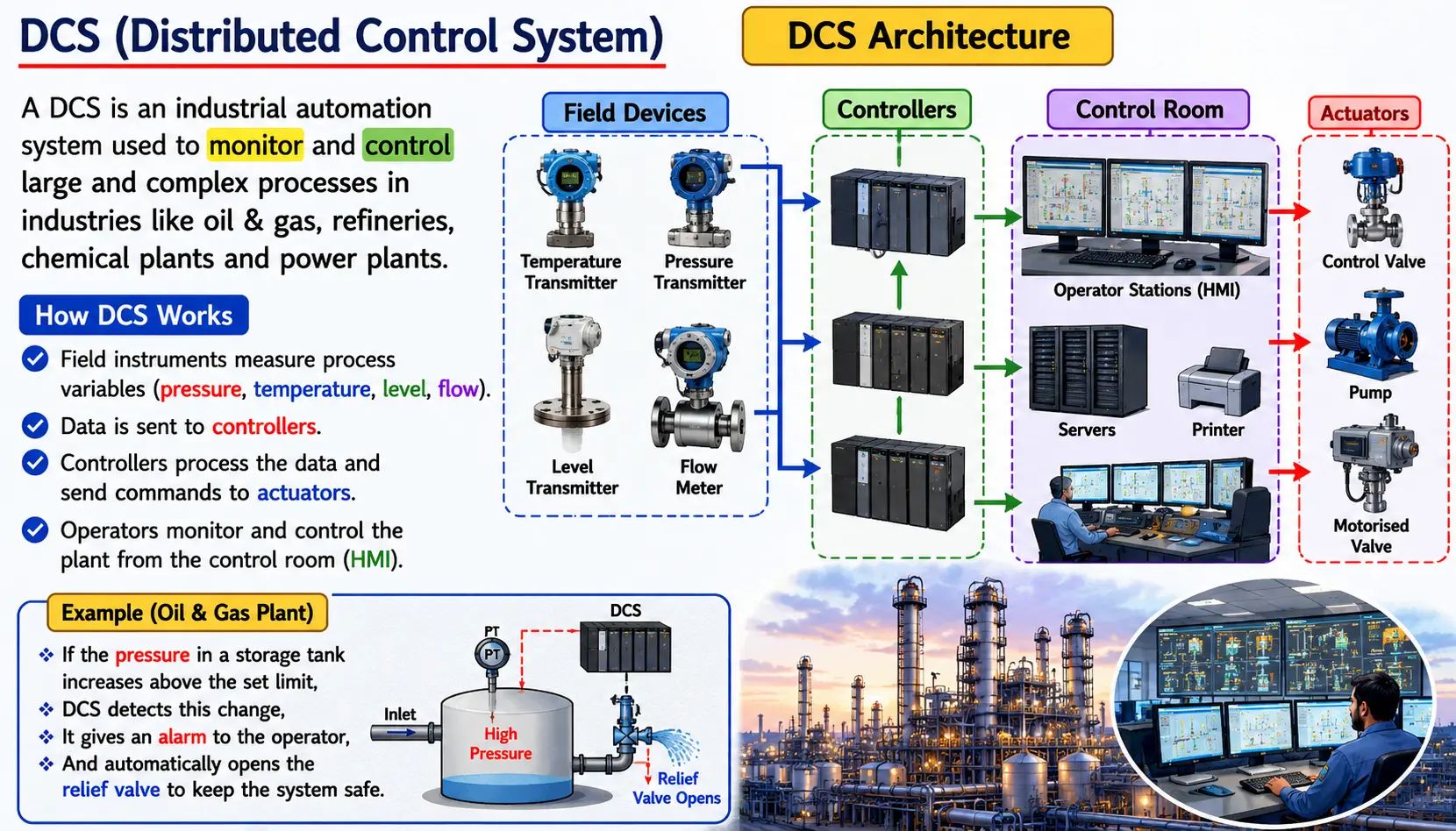
See lessWhat is the difference between RFCC and FCC in refinery?
In a refinery, FCC and RFCC are both cracking units used to convert heavy oil into lighter valuable products like gasoline, LPG, and diesel. The main difference is the type of feedstock they process and how “heavy” that feed is. FCC (Fluid Catalytic Cracking) Purpose Converts relatively lighter heavRead more
In a refinery, FCC and RFCC are both cracking units used to convert heavy oil into lighter valuable products like gasoline, LPG, and diesel.
The main difference is the type of feedstock they process and how “heavy” that feed is.
FCC (Fluid Catalytic Cracking)
Purpose
Converts relatively lighter heavy oils into:
Typical Feed
These feeds are cleaner and contain:
Characteristics
Main Products
RFCC (Residue Fluid Catalytic Cracking)
Purpose
Processes much heavier refinery residue to maximize valuable products.
Typical Feed
These feeds are much dirtier and heavier:
Characteristics
Main Products
Simple Difference
Easy Operator-Level Understanding
Think of it like this:
RFCC is basically a tougher, heavier-duty version of FCC designed to extract value from low-quality residual oil.
Key Operational Difference for Operators
In RFCC units operators usually monitor more carefully:
Because residue feed creates:
Typical Refinery Use
Examples:
- Middle East heavy crude processing refineries often prefer RFCC.
- Petrochemical-focused refineries may use FCC for propylene production.
See lesshow to find job after completion of Diploma of associate Engineer?
After completing a Diploma of Associate Engineer (DAE), finding a job is not difficult—but you need the right direction and strategy. 🇬🇧 English (Simple & Human Answer) First, decide your field (Electrical, Mechanical, Civil, Instrument, Chemical, etc.). Then: 1. Prepare your CV Make a simple CVRead more
After completing a Diploma of Associate Engineer (DAE), finding a job is not difficult—but you need the right direction and strategy.
🇬🇧 English (Simple & Human Answer)
First, decide your field (Electrical, Mechanical, Civil, Instrument, Chemical, etc.). Then:
1. Prepare your CV
Make a simple CV with:
2. Apply in relevant industries
DAE holders are mostly hired in:
3. Use job platforms
Search daily on:
4. Visit companies directly
Many technical jobs in Pakistan are filled through walk-in interviews, so:
5. Build practical skills
Companies prefer practical knowledge:
6. Start small if needed
If you don’t get a good job immediately:
- Join as trainee or technician
- Gain 6–12 months experience
- Then switch to better positions
See lessWhat is RFCC unit ?
RFCC (Residual Fluid Catalytic Cracking) unit is a refinery unit that converts heavy residual oil (left after distillation) into lighter, more valuable products like gasoline, diesel, and LPG using a catalyst and high temperature. In short: It upgrades heavy oil into useful fuels.
RFCC (Residual Fluid Catalytic Cracking) unit is a refinery unit that converts heavy residual oil (left after distillation) into lighter, more valuable products like gasoline, diesel, and LPG using a catalyst and high temperature.
In short: It upgrades heavy oil into useful fuels.
See lessExplain Sweet Crude ?
Sweet Crude (Sweet Crude Oil) — Explained 🇬🇧 English Sweet crude oil is a type of crude oil that contains a very low amount of sulfur (usually less than 0.5%). Because of low sulfur content, it is: Easier to refine Produces less pollution (especially sulfur dioxide) More valuable in the market Why iRead more
Sweet Crude (Sweet Crude Oil) — Explained
🇬🇧 English
Sweet crude oil is a type of crude oil that contains a very low amount of sulfur (usually less than 0.5%).
Because of low sulfur content, it is:
Why it is called “sweet”?
In the early days, oil workers would taste or smell crude oil. Oil with low sulfur had a milder, “sweet” smell, so it was called sweet crude.
Advantages:
Comparison:
- Sweet crude → low sulfur, high quality
- Sour crude → high sulfur, needs more refining
See lessMax temperature at CDU fired heater outler
I am new to Refining. I intend to process Egina crude (API 27.3) in my CDU. I want to maximize diesel yield. To reach this goal, I intend to increase the temperature at the outlet of the fired heater to the maximum. What maximum temperature do you think I could go without coking? The crude assay isRead more
I am new to Refining.
I intend to process Egina crude (API 27.3) in my CDU. I want to maximize diesel yield. To reach this goal, I intend to increase the temperature at the outlet of the fired heater to the maximum.
What maximum temperature do you think I could go without coking?
The crude assay is here:
https://ts.totalenergies.com/wp-content/uploads/2021/07/EGINA.pdf
Thanks in advance
See lessHow to find job after completion of DAE Chemical 3 Year Diploma ?
After completing a DAE in Chemical, you have a lot of opportunities both in Pakistan and abroad (especially Gulf countries like Saudi Arabia, UAE, Qatar, and Oman). Here’s a complete, practical step-by-step guide to help you find a good job after your DAE Chemical 👇 🧪 1. Understand Your Career OptioRead more
After completing a DAE in Chemical, you have a lot of opportunities both in Pakistan and abroad (especially Gulf countries like Saudi Arabia, UAE, Qatar, and Oman).
Here’s a complete, practical step-by-step guide to help you find a good job after your DAE Chemical 👇
🧪 1. Understand Your Career Options
After DAE Chemical, you can work in a variety of industries:
Industries Hiring DAE Chemical:
Common Job Titles:
⚙️ 2. Build a Strong Resume (CV)
Your DAE Chemical CV should highlight:
👉 Tip: I can help you create a professional DAE Chemical CV template if you want.
🌐 3. Apply on Trusted Job Websites
Pakistan:
Gulf (Middle East):
👉 Use job titles like:
“DAE Chemical Plant Operator,”
“Chemical Technician,”
“Refinery Process Operator,”
“Water Treatment Operator.”
🧠 4. Gain Hands-on Experience
If you’re a fresh DAE, start with:
📜 5. Add Technical Certifications
Short courses improve your chances a lot:
🤝 6. Use Networking & Referrals
✈️ 7. Apply for Gulf Jobs After Some Experience
After 1–2 years of local experience, apply abroad.
Good positions include:
Popular Pakistani agencies sending DAE Chemical workers abroad:
📈 8. Keep Learning & Improving
💡 Bonus Tip:
Apply smartly — don’t send the same CV everywhere.
Customize your CV for each company based on the job title (e.g., “Lab Technician” or “Process Operator”).
See less