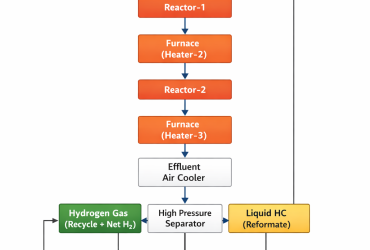
An Isomerization Unit in a refinery is a process unit used to convert straight-chain hydrocarbons (mainly naphtha) into branched-chain hydrocarbons to increase their octane rating. This process is particularly important for improving the quality of gasoline, as higher-octane fuels are ...
Technical knowledge Hub
The Continuous Catalyst Regeneration (CCR) unit is an essential part of a refinery, particularly for refining processes such as catalytic reforming. The primary function of the CCR unit is to maintain the activity of the catalyst used in the reforming ...
The Naphtha Hydrotreater (NHT) unit is an essential part of a refinery, particularly in the production of high-quality naphtha. The primary function of the NHT unit is to remove impurities such as sulfur, nitrogen, oxygen, and metals from the naphtha ...
Saqlain AbbasBegginer
In the oil and gas industry, particularly in refining, Motor Spirit (MS) refers to gasoline or petrol – the fuel used in internal combustion engines in vehicles. The term “block” in this context likely refers to a production block or ...
Saqlain AbbasBegginer
A tank farm (also known as a storage tank farm) is a facility where large quantities of liquids, such as oil, chemicals, or liquefied natural gas (LNG), are stored in large tanks. These tanks are usually designed to safely store ...
Saqlain AbbasBegginer
API Gravity is a measure of how heavy or light a petroleum liquid is compared to water. It is a scale developed by the American Petroleum Institute (API) to quantify the density of crude oil and other liquids. API Gravity ...
Crude oil can be classified into several types based on its characteristics, such as density, sulfur content, and origin. These characteristics significantly influence how crude oil is refined and its final uses. Here are the main types of crude oil: 1. ...