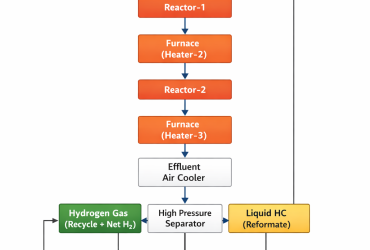
✔ Heat Exchangers – Used for feed preheating.✔ Hydrotreater Reactor – Contains catalyst for desulfurization.✔ Hot Separator & Cold Separator – Separate gases from liquids.✔ ...
Technical knowledge Hub
Operator Zone – Technical knowledge hub Latest Questions
🔹 The hydrogen recycle system:✔ Reuses excess hydrogen gas after separating it from reaction products.✔ Uses a recycle gas compressor to send hydrogen back to the reactor.
🔹 The stripper column removes:✔ H₂S & NH₃ – Prevents poisoning of downstream catalysts.✔ Light hydrocarbons – Improves product stability
🔹 Reactor temperature is controlled by:✔ Preheater adjustments – Regulates feed temperature.✔ Quench Hydrogen Injection – Reduces excessive heat in exothermic reactions.✔ Reactor Bed Temperature ...
✔ Cobalt-Molybdenum (Co-Mo) on Alumina – Used for low-sulfur feeds.✔ Nickel-Molybdenum (Ni-Mo) on Alumina – More active, used for high-sulfur feeds.
🔹 Causes of catalyst deactivation:✔ Coking – Formation of carbon deposits.✔ Metals Deposition – Vanadium & nickel accumulation.✔
✔ Hydrogen breaks S-C bonds, converting sulfur compounds into H₂S.✔ Prevents coke formation by saturating olefins.