

Dear All Operators Sign Up to our social questions and Answers Engine to ask questions, answer people’s questions, and connect with other people.
Login to our social questions & Answers Engine to ask questions answer people’s questions & connect with other people.
Lost your password? Please enter your email address. You will receive a link and will create a new password via email.
Please briefly explain why you feel this question should be reported.
Please briefly explain why you feel this answer should be reported.
Please briefly explain why you feel this user should be reported.

What is a DCS (Distributed Control System) & How a DCS Works ?
A Distributed Control System (DCS) is an industrial control system used to monitor and control large and complex processes in industries such as oil & gas, power plants, chemical plants, and refineries. Instead of controlling everything from one central computer, a DCS spreads the control acrossRead more
A Distributed Control System (DCS) is an industrial control system used to monitor and control large and complex processes in industries such as oil & gas, power plants, chemical plants, and refineries.
Instead of controlling everything from one central computer, a DCS spreads the control across multiple controllers placed in different areas of the plant. These controllers work together and communicate with a central control room where operators can monitor and manage the entire process.
How a DCS Works
A DCS collects data from different field devices like sensors, flow meters, pressure transmitters, and temperature gauges. This data is sent to local controllers. Each controller manages its own section of the plant and makes quick decisions based on the incoming signals.
The information is then displayed in the control room on operator screens (HMI – Human Machine Interface), where engineers can supervise the whole process in real time.
If any abnormal condition occurs, the system can automatically take action, such as adjusting valves, stopping pumps, or triggering alarms.
Simple Example
Imagine an oil refinery:
Each section has its own controller, but all are connected to a central control room.
If the pressure in a storage tank becomes too high, the DCS immediately detects it and can automatically open a relief valve or reduce the inflow to prevent any accident. At the same time, an alarm appears on the operator’s screen.
Key Idea
A DCS is designed for continuous and large-scale industrial processes where safety, accuracy, and real-time control are very important.
It helps operators manage complex plants efficiently while reducing the risk of human error.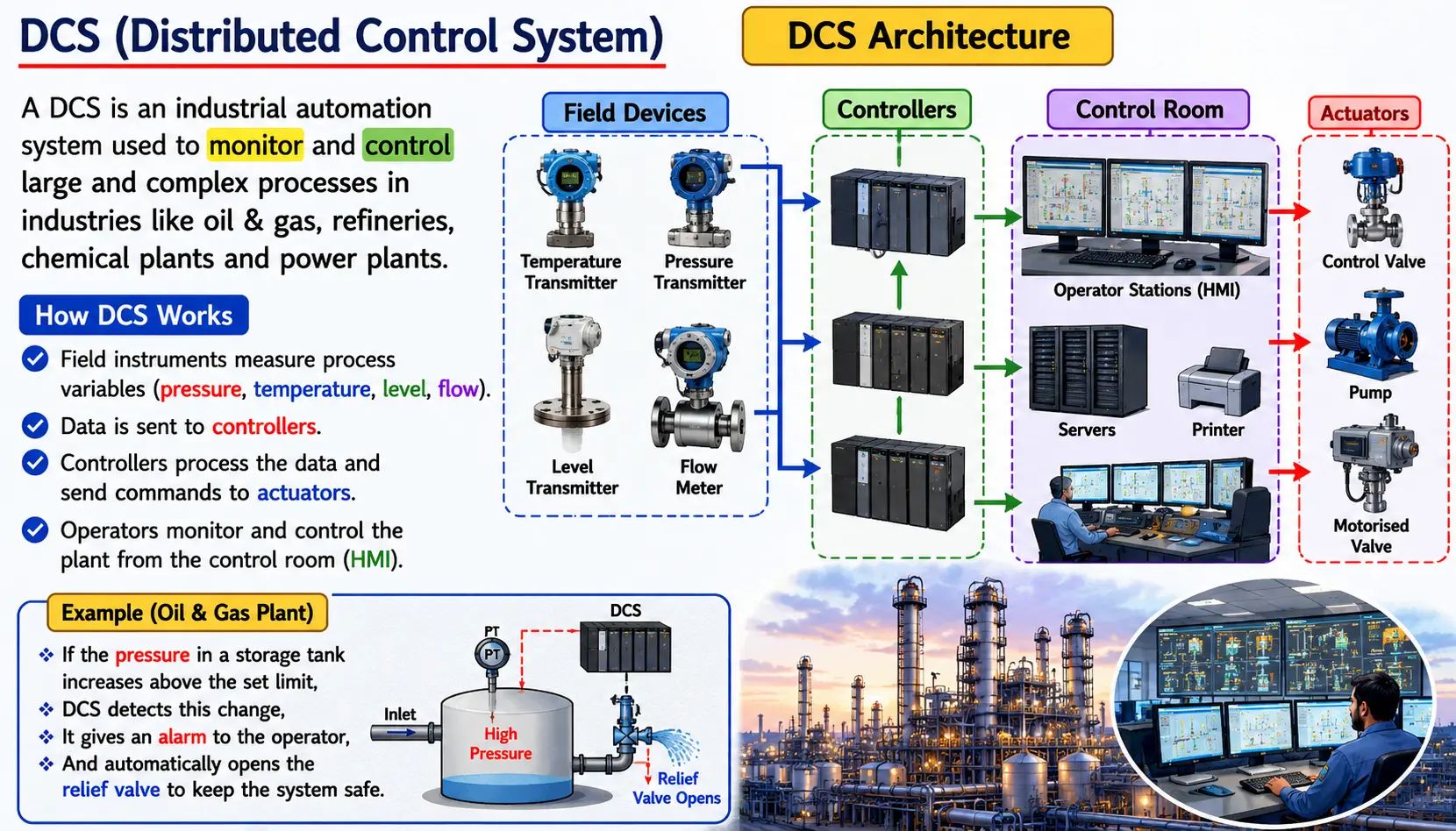
See lessWhat is the difference between RFCC and FCC in refinery?
In a refinery, FCC and RFCC are both cracking units used to convert heavy oil into lighter valuable products like gasoline, LPG, and diesel. The main difference is the type of feedstock they process and how “heavy” that feed is. FCC (Fluid Catalytic Cracking) Purpose Converts relatively lighter heavRead more
In a refinery, FCC and RFCC are both cracking units used to convert heavy oil into lighter valuable products like gasoline, LPG, and diesel.
The main difference is the type of feedstock they process and how “heavy” that feed is.
FCC (Fluid Catalytic Cracking)
Purpose
Converts relatively lighter heavy oils into:
Typical Feed
These feeds are cleaner and contain:
Characteristics
Main Products
RFCC (Residue Fluid Catalytic Cracking)
Purpose
Processes much heavier refinery residue to maximize valuable products.
Typical Feed
These feeds are much dirtier and heavier:
Characteristics
Main Products
Simple Difference
Easy Operator-Level Understanding
Think of it like this:
RFCC is basically a tougher, heavier-duty version of FCC designed to extract value from low-quality residual oil.
Key Operational Difference for Operators
In RFCC units operators usually monitor more carefully:
Because residue feed creates:
Typical Refinery Use
Examples:
- Middle East heavy crude processing refineries often prefer RFCC.
- Petrochemical-focused refineries may use FCC for propylene production.
See lessMax temperature at CDU fired heater outler
1. Typical CDU Furnace Outlet Temperature (COT) Normal operating range: 340–370°C Some units push to: 350–380°C 👉 This is the industry “safe zone” for atmospheric CDU. ⚠️ 2. Absolute Upper Limit (Before Cracking/Coking) Once you go beyond design: Around ~380°C+ → thermal cracking starts increasing ARead more
1. Typical CDU Furnace Outlet Temperature (COT)
Normal operating range: 340–370°C
Some units push to: 350–380°C
👉 This is the industry “safe zone” for atmospheric CDU.
⚠️ 2. Absolute Upper Limit (Before Cracking/Coking)
Once you go beyond design:
Around ~380°C+ → thermal cracking starts increasing
Above ~400°C → serious coking risk
Absolute extreme (rare, short-term): ~390–400°C max
Why?
Crude components (resins/asphaltenes) thermally decompose
Coke forms inside furnace tubes → pressure drop ↑ → tube hot spots → failure risk
Refiners avoid this deliberately (this is why VDU exists instead of higher CDU temp)
🧠 3. Key Insight (Important for You)
You cannot maximize diesel by just increasing temperature.
Because:
Higher temperature → more cracking → gas + naphtha, NOT diesel
Diesel yield depends more on:
Cut point optimization
Flash zone conditions
Reflux/pumparound
Stripping efficiency
👉 Overheating actually reduces diesel selectivity
⚙️ 4. What Controls Your REAL Temperature Limit
Your actual max is NOT a fixed number—it depends on:
✅ Crude type (Egina specifics)
Medium crude → moderate coking tendency
Likely safe ceiling: ~365–375°C
✅ Furnace design
Coil metallurgy
Heat flux (critical)
Residence time
✅ Velocity & steam injection
Higher velocity → less coke
Steam dilution → reduces partial pressure
✅ Run length target
1–2 years run → conservative temp
Short campaign → you can push slightly higher
📊 5. Practical Recommendation (For Your Goal: Max Diesel)
🔹 Safe operation range:
👉 350–370°C (optimal)
👉 370–375°C (aggressive but still controlled)
🔹 Avoid:
❌ >380°C continuous operation
❌ Trying to “force vaporization” of heavy ends
💡 6. Better Ways to Increase Diesel Yield (Instead of Temp)
If your goal is diesel maximization, do this:
Increase overflash (3–5%)
Optimize cut point (AGO endpoint)
Improve side stripper steam
Adjust flash zone pressure (slightly lower)
Optimize pumparound heat removal
👉 These give more diesel without coke risk
🧾 Final Answer
👉 For Egina crude in CDU:
Recommended max: ~370°C
See lessAggressive upper limit: ~375°C
Do NOT exceed: ~380°C (high coking risk)
How to find job after completion of DAE Chemical 3 Year Diploma ?
After completing a DAE in Chemical, you have a lot of opportunities both in Pakistan and abroad (especially Gulf countries like Saudi Arabia, UAE, Qatar, and Oman). Here’s a complete, practical step-by-step guide to help you find a good job after your DAE Chemical 👇 🧪 1. Understand Your Career OptioRead more
After completing a DAE in Chemical, you have a lot of opportunities both in Pakistan and abroad (especially Gulf countries like Saudi Arabia, UAE, Qatar, and Oman).
Here’s a complete, practical step-by-step guide to help you find a good job after your DAE Chemical 👇
🧪 1. Understand Your Career Options
After DAE Chemical, you can work in a variety of industries:
Industries Hiring DAE Chemical:
Common Job Titles:
⚙️ 2. Build a Strong Resume (CV)
Your DAE Chemical CV should highlight:
👉 Tip: I can help you create a professional DAE Chemical CV template if you want.
🌐 3. Apply on Trusted Job Websites
Pakistan:
Gulf (Middle East):
👉 Use job titles like:
“DAE Chemical Plant Operator,”
“Chemical Technician,”
“Refinery Process Operator,”
“Water Treatment Operator.”
🧠 4. Gain Hands-on Experience
If you’re a fresh DAE, start with:
📜 5. Add Technical Certifications
Short courses improve your chances a lot:
🤝 6. Use Networking & Referrals
✈️ 7. Apply for Gulf Jobs After Some Experience
After 1–2 years of local experience, apply abroad.
Good positions include:
Popular Pakistani agencies sending DAE Chemical workers abroad:
📈 8. Keep Learning & Improving
💡 Bonus Tip:
Apply smartly — don’t send the same CV everywhere.
Customize your CV for each company based on the job title (e.g., “Lab Technician” or “Process Operator”).
See less
What is The Deference between Hydrocrecker And Mild Hydrocracker
This is the Difference Between Hydrocracker and Mild Hydrocracker 🔹 Hydrocracker (Full / Conventional Hydrocracking) Operates at high severity conditions (high temperature & high pressure) Extensive cracking of heavy hydrocarbons into lighter products Produces large amounts of: LPG Naphtha KerosRead more
This is the Difference Between Hydrocracker and Mild Hydrocracker
🔹 Hydrocracker (Full / Conventional Hydrocracking)
🔹 Mild Hydrocracker (MHC)
🔥 Key Differences (Simple Table)
🎯 Simple One-Line Answer (for Interview)
👉 A hydrocracker performs deep conversion of heavy hydrocarbons into lighter products at high severity, while a mild hydrocracker operates at lower severity mainly to improve product quality with limited cracking.
See lessImportance of Education
Education is one of the most powerful tools in life. It helps individuals gain knowledge, develop skills, and build a better future. Through education, a person learns how to think, solve problems, and make wise decisions. Education also plays a key role in personal growth. It builds confidence, impRead more
Education is one of the most powerful tools in life. It helps individuals gain knowledge, develop skills, and build a better future. Through education, a person learns how to think, solve problems, and make wise decisions.
Education also plays a key role in personal growth. It builds confidence, improves communication, and opens doors to new opportunities such as good jobs and successful careers. An educated person can better understand the world and contribute positively to society.
Moreover, education helps in reducing poverty and inequality. It creates awareness about rights, responsibilities, and social values. A well-educated society is more developed, peaceful, and progressive.
In short, education is the foundation of success and a brighter future for individuals and nations alike.
Define ESD,FAT,SAT.
Emergency Shutdown (ESD) An Emergency Shutdown (ESD) is a safety procedure implemented in industries or systems to quickly and safely halt operations in response to a potential hazard, fault, or dangerous situation. The goal is to protect equipment, people, and the surrounding environment. Key PointRead more
Emergency Shutdown (ESD)
An Emergency Shutdown (ESD) is a safety procedure implemented in industries or systems to quickly and safely halt operations in response to a potential hazard, fault, or dangerous situation. The goal is to protect equipment, people, and the surrounding environment.
Key Points:
Purpose: The purpose of an ESD system is to minimize or prevent catastrophic events like fires, explosions, system failures, or hazardous chemical spills. This is especially important in high-risk industries like oil and gas, manufacturing, power generation, and chemical plants.
Components of an ESD system:
Emergency Stop Button: A physical or digital button that, when pressed, will immediately stop a system or machine to prevent harm.
Sensors and Monitoring Systems: These monitor for dangerous conditions such as abnormal pressure, temperature, or chemical leaks that may trigger an emergency shutdown.
Control Systems: Automated systems that activate in the event of an emergency, taking action to safely shut down operations without requiring manual intervention.
Common Scenarios for ESD Activation:
Industrial Manufacturing: If machinery malfunctions or poses a risk (like overheating, mechanical failure, or fire), an emergency shutdown prevents further damage or injury.
Power Plants: In power generation, if there’s a failure or abnormal operating condition, ESD procedures will engage to prevent equipment damage, reduce risk of fire or explosion, or protect workers.
Oil and Gas: In the event of a gas leak, pressure surge, or equipment failure, an emergency shutdown is necessary to protect workers, prevent environmental contamination, and minimize the risk of explosions.
Types of Emergency Shutdown:
Automated ESD: Triggered automatically by monitoring systems based on specific thresholds, such as excessive pressure, temperature, or leak detection.
Manual ESD: Activated by an operator or authorized personnel through an emergency stop button or control system.
Steps Involved in an Emergency Shutdown:
Detection: The system identifies a dangerous condition (e.g., a pressure leak, gas buildup, or system malfunction).
Activation: A signal is sent to shut down operations, which could involve stopping machinery, cutting power, or diverting harmful substances.
Action: The system takes steps to ensure safety, such as shutting off valves, activating fire suppression systems, or bringing equipment to a safe state.
Recovery: After the emergency, the system may go through a controlled restart process to assess and address any damage before returning to normal operation.
Summary of Differences:
-
-
See lessESD (Electrostatic Discharge): A sudden release of static electricity that can cause damage to electronic components.
ESD (Emergency Shutdown): A safety procedure designed to stop operations in an emergency situation to protect people, equipment, and the environment.
What is API Gravity?
API gravity is a crucial metric for determining the characteristics and quality of crude oil, influencing how it is refined and its market value. Higher API gravity indicates lighter oil that is easier to refine, while lower API gravity denotes heavier oil, which is harder to refine and typically prRead more
API gravity is a crucial metric for determining the characteristics and quality of crude oil, influencing how it is refined and its market value. Higher API gravity indicates lighter oil that is easier to refine, while lower API gravity denotes heavier oil, which is harder to refine and typically produces more residual products.
See lessWhat is surging in compressor ?
Low flow at suction of compressor. Failure of anti surge valves. Chocking of compressor suction pjpe. Very high rotation speed and insufficient flow