PSM stands for Process Safety Management. It is a regulatory framework and system designed to help companies prevent and manage the risks associated with the handling of hazardous chemicals and processes. The goal of PSM is to protect employees, the ...
Technical knowledge Hub
Operator Zone – Technical knowledge hub Latest Questions
Saqlain AbbasBegginer
Safety refers to the condition of being protected from harm, danger, or risk. In the context of the workplace or daily life, safety involves taking steps to prevent accidents, injuries, and other negative outcomes by identifying hazards, minimizing risks, and ...
Crude oil can be classified into several types based on its characteristics, such as density, sulfur content, and origin. These characteristics significantly influence how crude oil is refined and its final uses. Here are the main types of crude oil: 1. ...
Saqlain AbbasBegginer
A tank farm (also known as a storage tank farm) is a facility where large quantities of liquids, such as oil, chemicals, or liquefied natural gas (LNG), are stored in large tanks. These tanks are usually designed to safely store ...
Saqlain AbbasBegginer
In the oil and gas industry, particularly in refining, Motor Spirit (MS) refers to gasoline or petrol – the fuel used in internal combustion engines in vehicles. The term “block” in this context likely refers to a production block or ...
The Naphtha Hydrotreater (NHT) unit is an essential part of a refinery, particularly in the production of high-quality naphtha. The primary function of the NHT unit is to remove impurities such as sulfur, nitrogen, oxygen, and metals from the naphtha ...
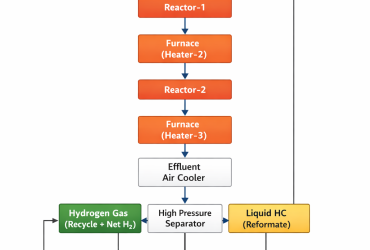
The Continuous Catalyst Regeneration (CCR) unit is an essential part of a refinery, particularly for refining processes such as catalytic reforming. The primary function of the CCR unit is to maintain the activity of the catalyst used in the reforming ...